

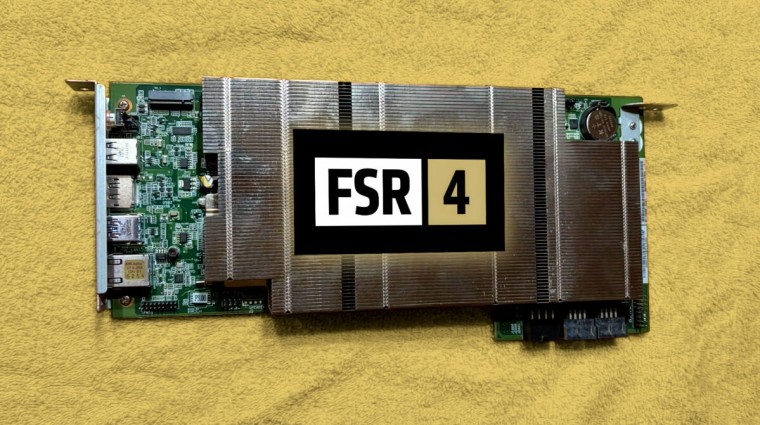
Modders Accelerated FSR 4 on AMD BC-250 with PS5 Chip – Former Mining Board Turns into a Gaming System
Hardware enthusiasts have been converting AMD BC-250 boards—originally deployed in 12-board ASRock mining rigs in 2022—into compact gaming systems. Those boards, built around selected Ariel/Oberon dies comparable to PlayStation 5 silicon, flooded the secondary market after the mining downturn; early resale prices were about $100–120, while units now typically start around $170 without cooling, a case, or a power supply.
Beyond sourcing and hardware mods, the community has pushed the BC-250’s silicon well past stock specifications. On compatible units modders have unlocked as many as 40 physical RDNA 2 compute units instead of the shipped 24, and custom firmware updates can enable all eight Zen 2 CPU cores where boards originally exposed six.
Their latest focus has been performance tuning for FidelityFX Super Resolution (FSR) 4.1.1. In an updated build (v4.0.0-rc9) the cost of running the upscaler has been cut substantially: in Quality mode at an output of 2560×1440 with a native render size of 1706×960 the FSR processing time fell from 11.51 ms to 5.92 ms. At 4K the processing time went from 25.72 ms to 12.08 ms, and at 1080p it decreased from 7.13 ms to 3.93 ms. These figures reflect the upscaler processing time only, not the full frame time. In controlled comparisons the optimized implementation produced output images that were bit-for-bit identical to the original.
The optimized DLL can be deployed through OptiScaler or used directly in games that include a native FidelityFX implementation. All reported tests so far were run on BC-250 hardware under Linux using standard Mesa and GE-Proton; Windows, other GPUs, and frame generation scenarios have not yet been evaluated. The developer working on the optimization suggests that roughly 1440p is the practical upper limit for this approach, since FSR 4 remains computationally heavy at 4K even after the improvements.
The broader BC-250 project continues to expand: the community has produced more than 145 case and enclosure designs, and contributors are active on firmware, GPU management, memory, audio, telemetry, Bazzite integration, ROCm support, and unlocking additional CPU cores and GPU compute units. What began as commodity mining hardware is increasingly being transformed by modders into capable, compact gaming Linux systems.