

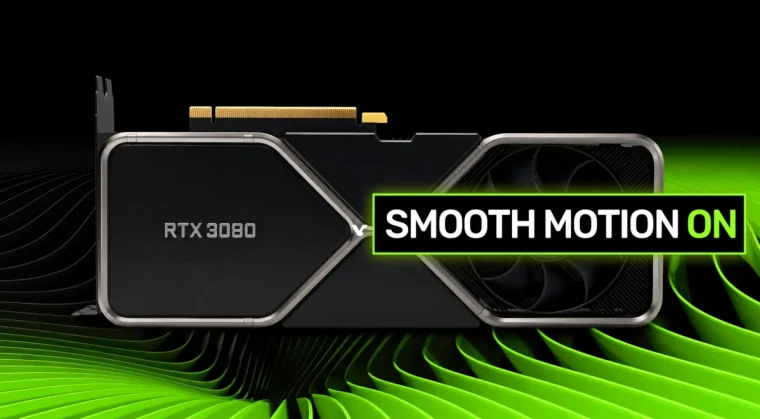
Modders Added NVIDIA Smooth Motion to GeForce RTX 30 in Two Ways – Support Remains Experimental
Modders have managed to bring NVIDIA’s Smooth Motion frame generation to GeForce RTX 30-series cards through two independent projects, demonstrating that the functionality can run on Ampere hardware even though NVIDIA’s official driver-level support is limited to newer GPUs. These community efforts are unofficial, can be tricky to install, and are generally not recommended for online play because altered files may trigger anti-cheat systems. Meanwhile, NVIDIA continues to promote DLSS 5 and has been organizing sales of Founders Edition graphics cards at recommended prices. In theory, NVIDIA could enable official frame generation support for Ampere if it chose to provide that support via its software stack.
NVIDIA officially added Smooth Motion for the GeForce RTX 40 series last year. The driver-level frame generation option is available only to owners of GeForce RTX 40 and newer cards and does not appear in the NVIDIA App for Ampere GPUs. Users seeking similar features on older cards have other options such as FSR Frame Generation and Lossless Scaling. Earlier this month, enthusiasts adapted the DLSS-G runtime for the SM86 architecture used in GeForce RTX 30 cards; that effort later expanded beyond simple 2X frame generation to include Multi Frame Generation modes. While both DLSS-G and Smooth Motion add frames, Smooth Motion runs at the driver level and therefore supports a wider range of games because it does not require native DLSS Frame Generation integration.
The first project extends an existing mod for SM86. The initial Smooth Motion implementation was produced by pipotoufikxyz-lgtm, who previously enhanced sdli1995’s dlssg_for_sm86 project by adding extra frame generation modes. That work has since been extended to incorporate Smooth Motion and Vulkan support. The first release with Smooth Motion arrived on September 19 and was tested on a GeForce RTX 3070. Installation involves placing the supplied DLL alongside the game executable and enabling Smooth Motion via NVIDIA Profile Inspector.
This fork is distributed as dlssg_for_sm86-MFG-version. Testing has reached other Ampere cards: an RTX 3080 owner reported Smooth Motion functioning in several PC titles and in the RPCS3, DuckStation, and Yuzu emulators, though some Steam games crashed when launched through the store client. That same user observed more pronounced artifacts on the RTX 3080 compared with an RTX 5070 Ti. As a result, the mod remains experimental and should not be viewed as a full substitute for NVIDIA’s official implementation.
NVSmooth30 uses a different approach. The second effort, NVSmooth30, was developed by ItsAdeline as an experiment to make the Smooth Motion execution path compatible with SM86 hardware via NVIDIA’s NvPresent64.dll. Rather than building on the DLSS-G package, NVSmooth30 scans and modifies NvPresent compatibility checks, intercepts the CUDA loading sequence, and redirects compatible SM89 kernels to run on SM86. The project also contains an experimental image output bridge that converts DirectX 11 output to DirectX 12.
NVSmooth30 was first shown running on an RTX 3050 Laptop GPU; another user reported success on an RTX 3070. ItsAdeline credits sdli1995’s DLSS-G work as an inspiration but says NVSmooth30’s codebase was written independently. Both projects’ authors warn that compatibility is limited: injecting the DLL can cause crashes and may conflict with anti-cheat systems. They recommend these tools only for experimental use in single-player games and stress that users proceed at their own risk.