

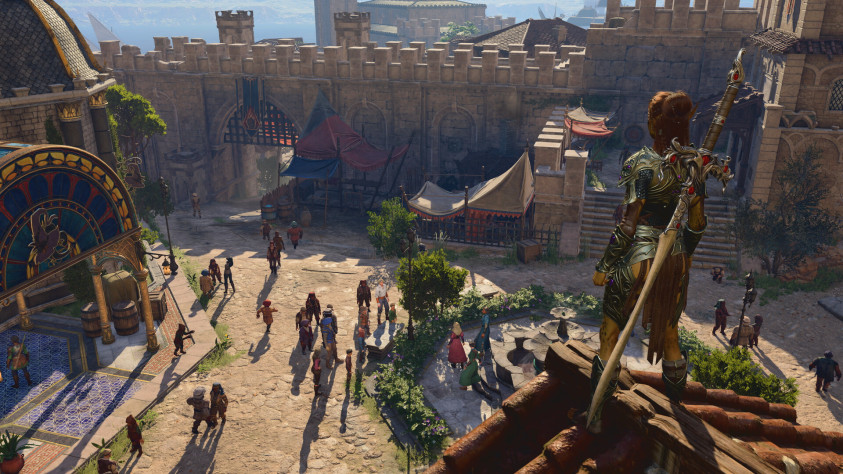
Former BioWare developer Mark Darrah argues that the reason Baldur’s Gate 3 clicked with players is not because Larian Studios slavishly reproduced the old titles. He says they kept the franchise’s essence while grafting on fresh ideas and two decades’ worth of hard-won lessons — with a few personal touches, one might add.
Darrah got his start as a programmer on the first two Baldur’s Gate games and later served as executive producer on Dragon Age. In a chat with FRVR he put Larian and Obsidian approaches side by side. His take: Pillars of Eternity nails the feel of Infinity Engine classics — which is both a strength and a limitation, he felt.
Pillars of Eternity feels like an Infinity Engine game. Although it really isn’t. I played it and thought, "Wow, it’s very much like a spiritual successor to Baldur’s Gate, Icewind Dale, or something along those lines. Some of the same people worked on it." And I can’t fault the game for how accurately it follows its sources of inspiration. But the industry has changed so much since then that at some point I thought, "Yeah, this is a very accurate continuation of that era." And it turned out that I no longer wanted exactly that. Mark Darrah
Darrah points out that Larian chose another road. Baldur’s Gate 3 wears the legacy of the early entries but also borrows from the Divinity series, from the studio’s own background, and from CRPG innovations of the last ~20 years — e.g., systems and design ideas that wouldn’t have existed in 2000.
He also flagged the long hiatus as a key factor. With Baldur’s Gate 2 dating to 2000, a straight rehash of then-current mechanics would’ve felt dated; Larian instead used that familiar base and retooled it for modern expectations (i.e., updated pacing, UI, and player agency).
But there’s a wrinkle for the IP owner, Hasbro. Darrah warns that after a project this successful it’ll be tough for another team to step in and make a full-fledged fourth entry without living in Larian’s shadow — esp. if fans keep measuring everything against BG3.